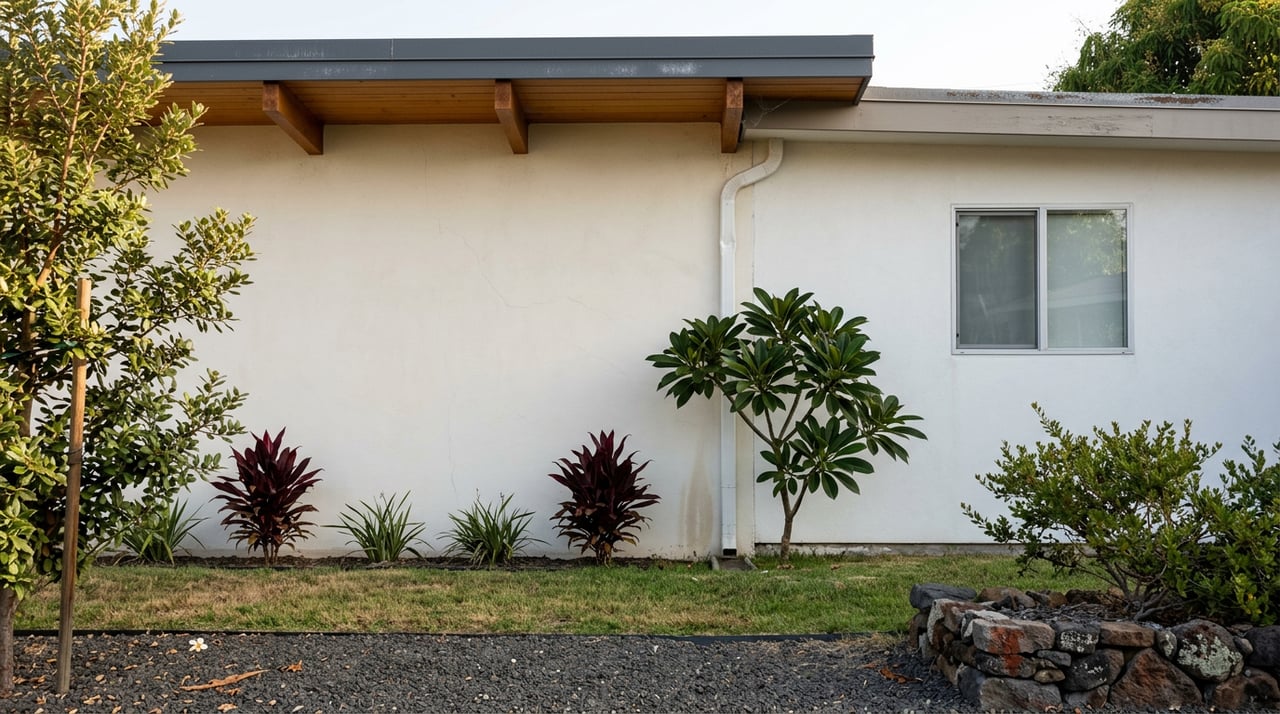
A converted garage in Kailua-Kona can look, on a walkthrough, exactly like a legal third bedroom. It can have a bed, a closet, a private entrance, even a small counter with a mini-fridge and a hot plate. None of that tells you what your lender will actually pay for it. The number that matters sits in a county record you will not see on a house tour, and it usually comes down to one detail: whether the room has a stove and a full-size sink.
That is not a metaphor. Hawaii County's own definition of a "kitchen," for permitting purposes, is a stove plus a full-size sink. Miss either one and the space is a "recreation room," permit-legal but not a dwelling unit. Add both and it becomes a kitchen, which changes what the county allows and what an appraiser is willing to count toward value. That single distinction is why so many Kailua-Kona listings carry the quiet line "some areas not permitted," and why the phrase is doing far more financial work than it looks like on the page.
What "some areas not permitted" is actually telling you
Two separate things happen the moment a buyer reads that phrase.
First, it is a disclosure. Hawaii sellers are required to disclose known legal issues on the property, including unpermitted improvements or construction, as part of the state's mandatory seller disclosure statement. That obligation is why the phrase shows up in listing remarks at all. It is the seller and the listing agent covering themselves, not offering a full accounting of what the space is worth.
Second, and this is the part buyers underestimate, it is a warning about the appraisal. When a lender orders an appraisal and the appraiser finds square footage that was built without permits, or converted from one use to another without one, standard practice is to note it and exclude that portion's value from the loan calculation. If the entire structure, garage conversion, guest quarters, whatever it is, went up without any permit at all, no conventional lender will finance it. At that point the sale has to be cash, and the unpermitted status has to be disclosed as part of the deal.
That gap between what you are touring and what the bank will fund is the real subject of this post. The stove and the sink are not a curiosity. They are the mechanism that creates the gap.
Why the workaround is so common on this side of the island
Here is the pattern that turns up repeatedly in older Kailua-Kona homes where an owner has added guest quarters, ohana space, or a converted garage over the years.
An owner wants a small kitchen in the addition, maybe for a long-term guest, maybe for rental income. Full permitting for a second kitchen on a single-family lot raises questions the owner may not want to answer, so instead they apply for, and receive, a permit for a "recreation room": cabinets, a small bar sink, a fridge, a microwave, a hot plate. Nothing that meets the county's kitchen threshold. The final inspection passes. Then, after the inspector leaves for the last time, a stove goes in and the small sink gets swapped for a full-size one.
At that point the space functions as a kitchen. It just is not one on paper. Any agent walking the property can usually tell, and once it is visible it has to be disclosed as "some areas not permitted" in the listing.
The reason this shows up so often here is the sheer number of older lots that went through exactly this cycle, sometimes decades ago, long before the current owner bought the place. You are rarely buying a shortcut the current seller took. More often you are buying a shortcut two or three owners took, quietly, one at a time.
What the appraiser and the lender actually do with it
Once an appraiser identifies unpermitted work, none of the outcomes are cosmetic.
The unpermitted square footage gets excluded from the gross living area the appraiser reports, which lowers the appraised value relative to what the listing and the asking price imply. The lender then bases the loan amount on that lower, appraisal-supported figure, not on the price you agreed to, which can widen the gap between what you offered and what you can actually borrow. If the unpermitted portion is the entire structure, financing is off the table entirely and the transaction becomes cash-only.
None of that shows up while you are standing in the room enjoying the ocean breeze through the jalousies. It shows up on the appraisal report, usually after you are already in escrow with earnest money down and a closing date circled on the calendar.
How to check before you write the offer, not after
The fix is to pull the permit history yourself, or through your agent, before the appraisal becomes the first place you learn about it. Every Big Island parcel carries a Tax Map Key, and county permit records are indexed to that number rather than to the street address.
- Get the TMK from the listing or your agent. It will include a leading zone digit of 3, the code for Hawaii County.
- Search that TMK in Hawaii County's EPIC Online Permit System to see what permits were actually issued, and for what.
- Cross-reference the county's real property tax record for the parcel, which lists the permitted bedroom and bathroom count and the assessed square footage, against what you counted on the walkthrough.
- Flag any mismatch, an extra bedroom, a second kitchen, a bathroom that exists in person but not in the record, before you write the offer, so it becomes a negotiating point instead of a surprise during underwriting.
If the mismatch surfaces after you are already in escrow rather than before, you still have room to act. You can request a timeline extension while a contractor scopes retro-permitting, or renegotiate price to reflect the appraisal gap. Both options exist. Neither is as clean as catching it before you write the offer.
This is the same kind of due diligence worth pairing with a check of a property's lava zone designation, another Big Island-specific detail that has nothing to do with condition and everything to do with what a lender will approve.
The two paths once unpermitted space is found
If an inspection or a permit pull turns up unpermitted square footage, a seller or buyer has two real options, and they lead to very different timelines.
| Path | What it involves | What it changes |
|---|---|---|
| Retro-permit | Hire a licensed contractor or permit specialist to bring the space to current code and file for permits after the fact | Can restore the space's value to the appraisal, but adds real time and may require opening finished work back up for inspection |
| Remove | Take out the unpermitted improvement, demolish the added kitchen fixtures or the non-conforming room | Resolves the appraisal issue immediately but reduces the livable space you are actually buying |
Neither path is free, and neither is instant. Pulling the permit history before you offer means you get to choose which path you are willing to live with, rather than discovering the choice has already been made for you at week six of escrow.
FAQ
Does an unpermitted addition mean the current seller did something wrong? Not necessarily. Many of these additions were built and altered years or decades before the current owner purchased the property, sometimes by an owner two or three sales back. The current seller still has to disclose what they know, but the history behind the work is often inherited, not created.
Can I still get a loan if only part of the house is unpermitted? Often yes, though the loan amount will typically be based on the appraised value with the unpermitted portion excluded, not on the full square footage you toured. Ask your lender early how they intend to treat it, before you are counting on a specific loan amount to make the numbers work.
What happens if the mismatch turns up mid-escrow instead of before I offer? You can request more time for a contractor to scope retro-permitting, or renegotiate price to reflect the appraisal gap. Both are workable, but both cost time you would not have spent if the TMK check had happened before the offer went in.
Where do I actually look up permit history myself? Start with the parcel's TMK and search it in Hawaii County's EPIC Online Permit System, then compare what you find against the county's real property tax record for the same TMK, which shows the permitted bedroom, bathroom, and square footage figures the county has on file.
That single line, "some areas not permitted," is not a footnote. It is the county telling you, in four words, that the appraisal and the walkthrough are about to disagree with each other. Knowing which detail decides that disagreement, and how to check it before you are committed, is the difference between a smooth escrow and a renegotiation at week six.
If you are weighing a Kailua-Kona property with any question mark in the permit history, or want a straight read on what a listing's disclosure language actually means for financing, Hawaii Estates can walk the TMK and county record with you before you write an offer. Get your Instant Home Valuation and let's talk about what is underneath the listing.