Buying in South Kona often comes with one question that surprises even experienced buyers: where will your water come from? If you are moving from an area where public water is the default, South Kona can feel different fast. The good news is that both county water and rain catchment can work well here, but they come with very different responsibilities, costs, and planning needs. If you understand those differences before you write an offer, you can make a much more confident decision. Let’s dive in.
Why water matters in South Kona
South Kona is a long, largely rural district with a major rainfall gradient. According to the South Kona community wildfire protection plan, average rainfall is under 30 inches a year along the coast and climbs to more than 100 inches on the slopes above the coffee belt.
That variation helps explain why water service is not the same from one property to the next. The same plan states that more than half of South Kona residents depend on rain catchment and hauled or delivered potable water, and that Ho‘okena is the southernmost area served by municipal water. South of Ho‘okena, buyers should not assume county water is available.
County water vs. catchment
At a basic level, county water and catchment solve the same problem in two different ways. County water is a public utility system managed by Hawai‘i County Department of Water Supply, while catchment is a private, owner-managed system that collects rainwater from the roof and stores it in a tank.
Neither option is automatically better for every buyer. The better fit usually depends on the parcel, your financing, and how comfortable you are with maintenance and monitoring.
What county water usually offers
For many buyers, county water feels familiar. Instead of maintaining your own collection and treatment setup, you pay recurring utility charges and rely on a public system for delivery.
According to the Department of Water Supply rate brochure, a bill can include a standby charge, a consumption charge, a power cost charge, and an energy CIP charge. For a 5/8-inch meter, the standby charge is $35.93 per month effective July 1, 2026, and the first general-use tier is $1.64 per 1,000 gallons.
County water can also involve upfront connection costs. That same DWS brochure lists a 5/8-inch service lateral connection at $3,000 on the same side of a county right-of-way and $4,000 across the road, plus a $1,319 facilities charge for the first 5/8-inch connection.
Another advantage is public monitoring. DWS publishes regional water quality reports, including Kona well data, so you can review public testing information instead of relying only on seller comments.
What county water does not guarantee
County water is convenient, but it is not the same as unlimited water on demand. DWS has advised customers to have alternate potable water during prolonged power shutoffs, and the department has also issued broader conservation notices in Kona when wells or equipment were under stress, as noted in its service impact notice.
That means county water reduces homeowner maintenance, but it does not remove the need for emergency planning. In South Kona, it still makes sense to ask how a property handles outages, storage, and backup needs.
How rain catchment works
Rain catchment is common across Hawai‘i Island and especially relevant in South Kona. The University of Hawai‘i CTAHR rainwater catchment guide describes it as roof collection through gutters and downspouts into a storage container, and it estimates that 30,000 to 60,000 people in Hawai‘i depend on catchment systems, with most of them on Hawai‘i Island.
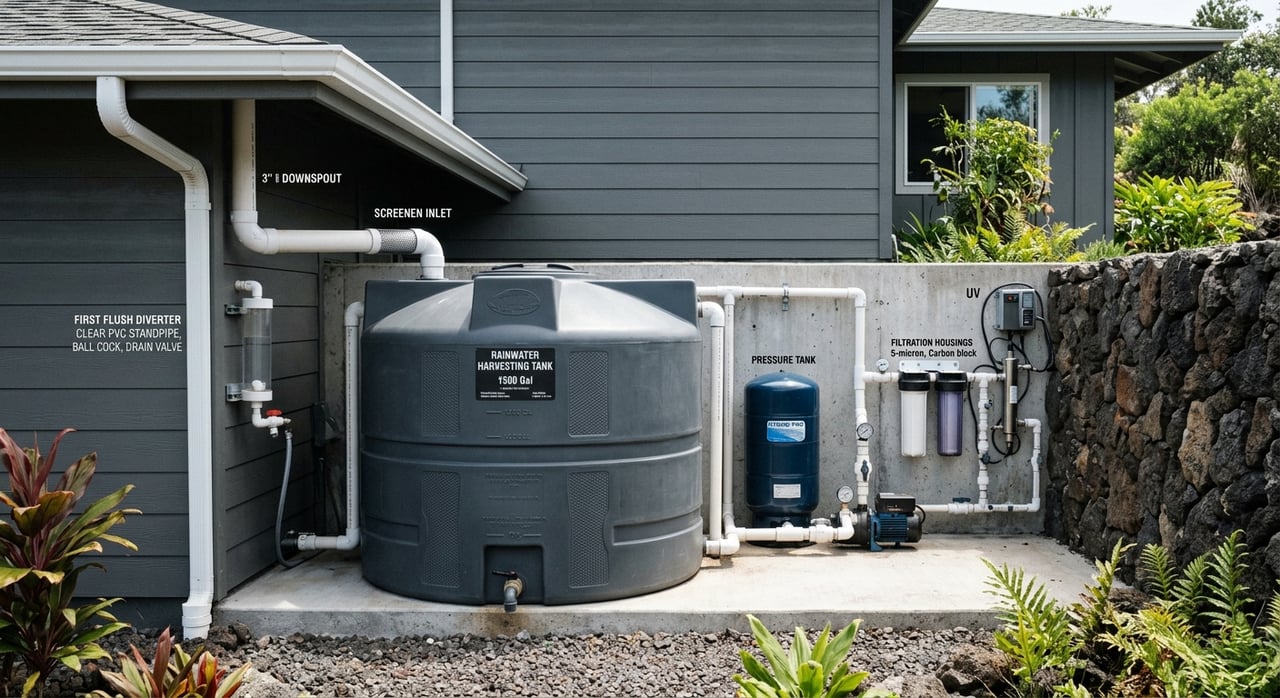
In practical terms, a catchment home turns the roof, tank, pump, filters, and treatment equipment into part of the property’s core infrastructure. If you buy a catchment property, you are not just buying a tank. You are buying a system that needs regular attention.
Why catchment can work well
Catchment is not unusual or a red flag in South Kona. In many areas, it is simply part of how residential living works. For the right buyer, it can be a practical solution that fits a rural property well.
It may also mean you are less tied to a monthly public utility bill. But that does not mean the water is free. The costs shift from utility charges to cleaning, testing, filters, treatment equipment, repairs, and replacement cycles.
Why catchment needs active management
The Hawai‘i Department of Health Safe Drinking Water Branch says individual-home catchment systems are not regulated by the department. It also recommends that systems be well designed, regularly maintained, and periodically tested.
DOH specifically recommends cleaning the roof, gutters, tank, and filters, along with considering certified filtration and treatment. It also recommends screening for E. coli, turbidity, lead, and copper. Posted acceptable levels include no E. coli, turbidity of 5 NTU or less, lead of 0.010 mg/L or less, and copper of 1.3 mg/L or less.
This is one of the biggest mindset shifts for buyers coming from municipal-water areas. With catchment, water quality is not something you assume. It is something you verify and maintain.
What buyers should inspect on a catchment property
If a South Kona home is on catchment, ask for details early. The water source can affect your comfort with the property, your lender requirements, and your short-term expenses after closing.
Here are the basics to review:
- Tank age and approximate size
- Roof material and condition
- Gutters and downspouts
- Pump and pressure system
- Filtration or UV treatment equipment
- Date of the last tank cleaning
- Date and results of the last water test
Chemistry matters too. The CTAHR catchment resource notes that rain is usually acidic, low pH can leach metals from roofing and system components, and new concrete tanks can make water more basic until they age. For buyers, that means tank material, roof material, and treatment setup matter just as much as tank size.
The DOH also notes that it subsidizes lead and copper testing once per year for a legal dwelling using catchment, with the owner paying shipping and a $25 lab fee. That is helpful because it reinforces an important point: routine testing is part of responsible ownership.
Financing can change the conversation
If you are using financing, water source should be confirmed early in escrow. This is especially important for individual water systems.
For VA buyers, the current VA Lender’s Handbook says water quality for an individual water supply must meet the local health authority’s requirements, or EPA standards if there are no local requirements. It also states that testing must be done by a disinterested third party, and that appraisers must obtain a veteran’s signed statement when the home is supplied by a rainwater catchment system.
The practical takeaway is simple: if you plan to use VA financing, verify the water source right away and ask what documentation will be needed. Waiting until appraisal can create unnecessary delays.
Insurance and risk planning still matter
Water source is only one part of the property-risk picture in South Kona. Insurance conversations should also include location-specific hazards and what a standard policy may not cover.
According to the State of Hawai‘i insurance consumer guidance, standard homeowners policies in Hawai‘i generally do not cover flood, hurricane, or earthquake losses. FEMA also says most homeowners insurance does not cover flood damage, so flood insurance is a separate policy.
South Kona also has a wildfire context. The South Kona community wildfire protection plan describes the district as rural, drought-prone, and fire-prone, and notes that limited water resources and hauled-water dependence can make fire suppression harder. That does not mean one water source is automatically wrong. It does mean storage, access, defensible space, and emergency planning deserve careful review.
A practical South Kona water checklist
When you are evaluating a property, try to treat water the same way you would treat roof condition, septic, or permitting. It is a key part of the home’s real-world livability.
Use this checklist as a starting point:
- Verify the actual water source. Confirm by address or TMK using DWS tools and water-availability contacts through the DWS water rates and service resources page.
- Ask the seller for specifics. If it is catchment, ask about tank size, age, cleaning, pump, filters, UV, and recent testing. If it is county water, ask for recent bills, meter size, and whether any connection or standby charges apply.
- Budget for the real cost. County water means recurring utility charges. Catchment means maintenance, testing, treatment, and replacement cycles.
- Do not assume municipal service below Ho‘okena. In much of southern South Kona, catchment and hauled water are part of normal property ownership.
- Match the property to your comfort level. Some buyers want the familiarity of a utility bill. Others are comfortable managing a well-maintained catchment system.
Which option is better for you?
In South Kona, the better question is usually not whether catchment or county water is universally better. The better question is which system fits the property and your lifestyle best.
If you want a more familiar utility setup and public monitoring data, county water may feel more comfortable. If you are open to a rural property and understand the maintenance side, catchment can be a practical and common solution in this part of the island.
The key is to verify the facts early and evaluate the water system with the same care you would give any major home component. If you want help sorting through a South Kona property’s water setup, location details, and due diligence steps, connect with Hawai'i Estates. We bring local Kona knowledge, practical property insight, and careful transaction support so you can move forward with clarity.
FAQs
What water source is common in South Kona homes?
- In South Kona, many homes rely on rain catchment and hauled or delivered potable water, and the South Kona community plan says more than half of residents depend on those systems.
Is county water available everywhere in South Kona?
- No. The South Kona wildfire protection plan identifies Ho‘okena as the southernmost area served by municipal water, with areas farther south relying on catchment and hauling.
What should buyers ask about a South Kona catchment system?
- Ask about tank age and size, roof material, pump and pressure system, filtration or UV equipment, last cleaning, and recent water test results.
Does Hawai‘i County regulate home rain catchment systems?
- No. DWS says it does not recognize or regulate rainwater catchment, and DOH says individual-home catchment systems are not regulated, though regular maintenance and testing are recommended.
Can a South Kona catchment home affect VA financing?
- Yes. The VA handbook says individual water supplies must meet applicable standards, require third-party testing, and may involve additional documentation during the appraisal process.
Does county water mean no water planning is needed in South Kona?
- No. DWS has advised customers to prepare for alternate potable water during prolonged power shutoffs, so backup planning still matters even on county water.